Compare Coastal Siding Systems USA: Comprehensive Building Envelope Analysis
Coastal building environments expose exterior cladding to relentless physical forces that rapidly degrade standard building materials. High-velocity wind events drive moisture into tiny envelope gaps, while airborne sea salt corrodes standard steel fasteners. Compare Coastal Siding Systems USA. Solar radiation breaks down synthetic polymer coatings, while extreme moisture cycles encourage wood decay, mold colonization, and substrate failure.
Architectural specifiers must evaluate coastal wall performance using multi-layer hygrothermal mechanics rather than reliance on single-attribute product warranties. Materials react differently depending on whether they face Atlantic tropical humidity, Pacific marine dampness, or Gulf hurricane winds. Choosing inappropriate cladding profiles leads to catastrophic bulk water intrusion, framing decay, insulation degradation, and structural failure.
Protecting coastal structures requires integrating exterior siding panels into engineered rainscreen wall assemblies. Ventilated air gaps equalize pressure differences, preventing wind-driven water from penetrating inner moisture barriers. This reference provides an exhaustive evaluation of material physics, regional environmental dynamics, installation protocols, and lifecycle durability across major marine building zones.
Compare Coastal Siding Systems USA
To compare coastal siding systems usa effectively, building envelope engineers evaluate material chemistry alongside structural attachment protocols under extreme environmental stress vectors. Architects analyze wind uplift ratings, salt spray resistance, and capillary drying rates across various marine microclimates.
Environmental Stress Analysis
Evaluating marine cladding materials requires evaluating several overlapping physical forces that operate continuously across coastal boundary layers. High-velocity wind pressures create negative pressure zones along building corners, pulling panels outward and shearing weak structural fasteners.
Airborne chloride ions penetrate porous material surfaces, accelerating oxidation across standard galvanized steel flashings and structural nails. Continuous solar ultraviolet exposure degrades binder resins in paint finishes, causing surface chalking, micro-cracking, and color loss.
Pressure-Equalized Rainscreen Engineering
Pressure-equalized rainscreen assemblies prevent wind-driven rain penetration by eliminating the pressure differential between outdoor air and internal wall cavities. Outer cladding panels deflect bulk rainwater, while open drainage slots allow outdoor air to enter rear drainage cavities.
Equalizing air pressure across exterior cladding prevents suction from pulling water through panel joints and fastener holes. Stainless steel furring channels elevate siding boards away from weather barriers, creating vertical drainage paths for intruding water.
Oversimplification Risks in Marine Environments
A frequent mistake in marine wall design involves relying solely on surface sealants to prevent moisture entry behind exterior cladding. Sealants exposed to marine solar radiation, salt spray, and cyclic thermal expansion crack within three years, allowing bulk water entrapment.
Another common error involves utilizing standard galvanized fasteners instead of marine-grade 316 stainless steel hardware. Galvanized coatings dissolve rapidly in salt-laden coastal air, leading to hidden fastener shearing and sudden panel loss during high-wind events.
Deep Contextual Background
Historical Evolution of Marine Cladding
Early coastal builders relied on naturally rot-resistant timber species like virgin Western Red Cedar and Atlantic White Cedar. These dense wood fibers resisted decay, but required frequent oil treatments to prevent moisture warping under severe ocean weather.
Mid-century construction introduced synthetic vinyl and un-capped aluminum siding, marketed as low-maintenance alternatives for coastal properties. However, light vinyl panels cracked under tropical storm winds, while aluminum siding corroded around unsealed cut edges exposed to salt air.
Advances in Structural Material Science
Contemporary building codes mandate rigorous structural testing for cladding materials installed within high-velocity hurricane zones. Modern developments include fiber-reinforced cementitious composites, poly-ash matrices, co-extruded capped polymers, and marine-grade architectural metals.
Evaluating material science innovations when specifiers compare coastal siding systems usa ensures wall assemblies withstand tropical storms, salt corrosion, and extreme daily thermal swings.
Conceptual Frameworks and Mental Models
Navigating coastal wall design requires structured analytical frameworks to balance material durability, moisture drainage, and structural wind resistance.
1. The Marine Tri-Factor Degradation Matrix
This model evaluates material lifespan by measuring its vulnerability to three primary coastal stress vectors:
-
Chloride Ion Corrosion: Deterioration of metal components, fasteners, and structural connectors caused by salt spray.
-
Wind-Driven Hydraulic Pressure: Water penetration driven through microscopic material joints during severe gale-force winds.
-
Ultraviolet Polymer Breakdown: Solar radiation breaking down synthetic resins, paint finishes, and protective capstock layers.
Model Limitation: Does not account for localized physical impacts from flying storm debris during hurricane events.
2. The Pressure-Equalized Cavity Model
This framework tracks air pressure dynamics within rear-ventilated rainscreen cavities during high-wind storms.
-
Exterior Pressure Zone: Dynamic wind pressure pushing against outer siding faces.
-
Internal Cavity Zone: Rapid pressure equalization achieved through unobstructed base and head ventilation slots.
-
Substrate Protection Zone: Vapor-permeable weather barriers shielding structural sheathing from minor residual water droplets.
Model Limitation: Relies on completely unobstructed drainage slots across upper and lower wall perimeters.
3. The Lifecycle Chloride Resistance Index
This model ranks cladding systems based on their chemical stability when exposed to continuous marine salt atmospheres.
-
Inert Materials: Poly-ash, cellular PVC, and fiber cement exhibit zero chemical reaction to chloride exposure.
-
Passivated Metals: Marine-grade anodized aluminum and copper form protective oxide layers that halt deeper salt corrosion.
-
Coated Ferrous Metals: Standard galvanized steel relies on surface paints that degrade, exposing core metal to rapid rust.
Model Limitation: Assumes proper site handling without deep surface scratches that bypass protective coatings.
Key Categories or Variations Compare Coastal Siding Systems USA
Coastal Material Performance Metrics
| Material Category | Salt Corrosion Resistance | Wind Uplift Performance | Moisture Absorption Rate | Flame Spread Rating | Coastal Durability Index |
| Poly-Ash Composite | Impervious | Exceptional (110+ PSF) | Less than 1% | Class A Non-Combustible | Superior |
| Cellular PVC Cladding | Impervious | High (80 – 100 PSF) | Less than 0.5% | Flame Spread Class A | Very High |
| Fiber Cement Board | Excellent | High (75 – 95 PSF) | Moderate (3 – 5%) | Class A Non-Combustible | High |
| Capped Polymer Shake | Impervious | Moderate-High (70 – 90 PSF) | Less than 0.5% | Class B or C | High |
| Marine Aluminum Panel | Exceptional | Extreme (120+ PSF) | Zero | Class A Non-Combustible | Superior |
| FSC Tropical Hardwood | High (Natural Oils) | High (80 – 100 PSF) | Low-Moderate (2 – 4%) | Class A or B | High |
Poly-Ash Composite Assemblies
Poly-ash composite siding combines industrial fly ash with polyurethane binders, producing dense, non-porous architectural planks. This inorganic formulation absorbs virtually zero water, making it immune to rot, swelling, and freeze-thaw cracking in marine zones.
The structural installation order follows a clear sequence: Stud Framing, Plywood Sheathing, Self-Adhered Barrier, Vertical Furring, and Poly-Ash Planks.
Poly-ash boards cut easily with standard woodworking tools without releasing silica dust. High dimensional stability allows tight board butt joints, reducing reliance on synthetic caulking along coastal facades.
Cellular PVC Shingle and Lap Systems
Cellular PVC siding utilizes free-foam extrusion to create dense closed-cell cores protected by hard, smooth outer skins. This material resists salt spray and water absorption, making it suitable for low-lying coastal structures prone to tidal flooding.
Installing cellular PVC requires specifying oversized fastener slots to accommodate thermal linear expansion and contraction. Installers must apply light-colored paint finishes with high Solar Reflectance Index values to prevent heat distortion under direct sunlight.
High-Density Fiber Cement Panels
Fiber cement combines Portland cement, ground sand, cellulose fibers, and water to form dense, non-combustible cladding panels. This material offers Class A fire resistance and strong protection against wind-borne debris during coastal storm events.
All field-cut panel edges must be sealed immediately with acrylic primers to prevent moisture absorption along raw cut faces. Fastening fiber cement in coastal zones requires 316 stainless steel screws to prevent rust corrosion.
Marine-Grade Architectural Aluminum
Architectural aluminum siding features interlocking panel joints and concealed clip systems that provide high resistance to hurricane wind uplift forces. Factory-applied Kynar 500 fluoropolymer coatings protect aluminum substrates from salt spray corrosion and color fading.
Interlocking panel joinery prevents wind-driven rain penetration without relying on exposed elastomeric sealants. Floating attachment clips accommodate thermal movement across long panel runs during intense solar exposure.
FSC-Certified Tropical Hardwoods
Ipe, Cumaru, and Garapa hardwoods contain high natural oil densities that resist water absorption, fungal decay, and insect attack. These dense woods provide strong impact resistance against wind-borne debris in severe storm zones.
Installing tropical hardwoods requires pre-drilling pilot holes for 316 stainless steel face screws. Applying annual penetrating hardwood oils preserves natural wood tones, though un-oiled boards weather into a silvery-grey patina.
Capped Polymer Composite Shakes
Capped polymer shakes replicate the hand-split texture of natural cedar shingles while eliminating moisture rot, splitting, and combustion risks. Co-extruded synthetic capstocks shield internal polymer cores against UV fading and salt spray breakdown.
Polymer shakes incorporate engineered expansion overlap lines that accommodate material movement across wide temperature swings. Open rear drainage channels allow trapped moisture to drain freely down weather barrier faces.
Comparative Decision Logic
Selecting appropriate marine cladding systems requires evaluating wind zone maps, distance from salt water, fire codes, and maintenance budgets. Oceanfront properties located within hurricane zones benefit from marine aluminum panels or poly-ash cladding installed over ventilated rainscreen cavities.
High wildfire risk coastal scrub zones require non-combustible fiber cement or poly-ash panels secured with stainless steel hardware. Analyzing localized atmospheric vectors ensures selected cladding systems deliver multi-decade building envelope protection.
Detailed Real-World Scenarios Compare Coastal Siding Systems USA
Scenario 1: South Florida Hurricane Boundary Layer
A two-story beachfront property in Miami faces Category 5 hurricane wind risks, intense solar heat, high salt spray, and wind-driven rain storms.
The structural assembly order follows a strict sequence: Wind-Driven Rain, Aluminum Panel, Air Drainage Gap, Waterproof Barrier, and Masonry Wall.
Primary Constraint
Extreme wind uplift forces tear standard lap siding boards off exterior walls while salt air corrodes standard galvanized fasteners.
Selected Strategy
Marine-grade aluminum interlocking panels installed over self-adhered waterproof barriers and secured with 316 stainless steel clips.
Failure Modes
Using standard galvanized fasteners causes rapid salt corrosion, resulting in fastener head shearing and loss of siding panels during storms.
Second-Order Effects
Interlocking aluminum panels create a non-combustible building envelope that withstands hurricane winds and salt spray without surface degradation.
Scenario 2: Maine North Atlantic Marine Zone
A coastal home in Bar Harbor faces freezing ocean salt spray, heavy winter snowpack, deep freeze-thaw cycles, and summer ocean fog.
Primary Constraint
Trapped moisture inside porous siding materials freezes during winter, causing panel spalling and joint separation.
Selected Strategy
Poly-ash lap siding installed over vertical composite furring strips and vapor-permeable weather barriers.
Failure Modes
Fastening siding boards directly against wall sheathing without air drainage gaps traps moisture, rotting the structural plywood framing.
Second-Order Effects
Non-porous poly-ash composite boards eliminate water absorption, preventing freeze-thaw damage and keeping wall cavities dry.
Scenario 3: Outer Banks Barrier Island Exposures
A elevated beach home in North Carolina experiences continuous wind-driven sand, salt fog, high humidity, and tropical storm cycles.
The moisture drainage workflow moves sequentially: Driving Salt Rain, Polymer Shakes, Rear Air Gap, Permeable Barrier, and Plywood Sheathing.
Primary Constraint
Blowing sand strips paint off traditional timber siding, while continuous salt fog corrodes metal flashings and fasteners.
Selected Strategy
Capped polymer shakes installed over structured drainage mats and high-tack self-adhering flashings.
Failure Modes
Applying liquid-applied paint finishes on site leads to rapid chalking and peeling due to blowing sand and UV exposure.
Second-Order Effects
Factory-capped polymer surfaces resist sand abrasion and salt spray, eliminating painting cycles for over twenty years.
Scenario 4: Pacific Northwest Puget Sound Microclimate
A coastal residential home in Washington faces continuous low-intensity rainfall, high relative humidity, shaded tree canopy cover, and ocean mist.
Primary Constraint
Continuous moisture and low sunlight promote heavy moss, lichen, and surface mold growth across exterior building walls.
Selected Strategy
Fiber cement lap siding finished with factory-applied acrylic coatings, installed over vertical rainscreen furring channels.
Failure Modes
Omitting rear drainage channels allows moisture to linger behind panels, encouraging mold growth across wall sheathing.
Second-Order Effects
Ventilated rainscreen cavities dry internal wall assemblies through convective stack ventilation, stopping mold colonization.
Planning, Cost, and Resource Dynamics
Budgeting coastal siding installations requires calculating initial material procurement fees, marine-grade stainless steel hardware costs, scaffolding rentals, and ongoing maintenance reserves. Investing in high-performance weather barriers and rainscreen drainage systems increases upfront expenses but prevents costly structural framing repairs.
Marine Envelope Financial Breakdown
| Cladding System | Initial Installed Cost ($/sq ft) | Expected Service Life | 20-Year Maintenance Reserve | Total Lifecycle Cost Profile |
| Poly-Ash Composite | $16.00 – $28.00 | 50+ Years | Low ($1.50 – $3.50/sq ft) | Highly Economical |
| Cellular PVC | $14.00 – $24.00 | 40 – 50 Years | Low ($1.00 – $3.00/sq ft) | Highly Economical |
| Fiber Cement Board | $12.00 – $20.00 | 30 – 45 Years | Moderate ($3.50 – $7.00/sq ft) | Economical Upfront |
| Marine Aluminum Panel | $22.00 – $38.00 | 50+ Years | Lowest ($0.50 – $1.50/sq ft) | High Initial / Low OpEx |
| Tropical Hardwood | $20.00 – $36.00 | 30 – 50 Years | High ($6.00 – $12.00/sq ft) | High Ongoing Maintenance |
| Capped Polymer Shake | $18.00 – $30.00 | 35 – 50 Years | Low ($1.50 – $3.00/sq ft) | Balanced Long-Term Value |
Direct and Indirect Cost Factors
Direct expenses include cladding panels, trim boards, starter strips, 316 stainless steel fasteners, self-adhering weather barriers, furring channels, and marine-grade sealants. Indirect costs cover structural engineering calculations, scaffolding rentals, building permits, coastal waste hauling, and jobsite material storage protection.
Upgrading to poly-ash or marine aluminum panels increases initial material capital outlays. However, eliminating repainting cycles and preventing framing rot yields lower total lifecycle financial costs.
Supply Chain and Material Sourcing
Procuring specialty marine composite panels requires planning around factory production schedules and regional distributor stocking levels. Ordering extra material allowances ensures matching factory lots remain available for future field repairs.
Proper jobsite storage protects marine siding boards before installation. Planks should be stored flat on raised pallets and covered with breathable tarps to prevent moisture entrapment.
Tools, Strategies, and Support Systems
Executing coastal siding installations requires specialized cutting blades, pneumatic coil nailers, rainscreen furring strips, and self-adhering flashing membranes.
The installation workflow follows a clear sequence: Substrate Inspection, Self-Adhered Barrier Application, Furring Strip Attachment, Starter Strip Alignment, and Panel Fastening.
Polycrystalline Diamond (PCD) Saw Blades
Cutting dense fiber cement or poly-ash panels requires circular saw blades fitted with PCD teeth. PCD blades slice through dense materials cleanly, reducing silica dust and preventing board edge chipping.
Adjustable Depth Pneumatic Nailers
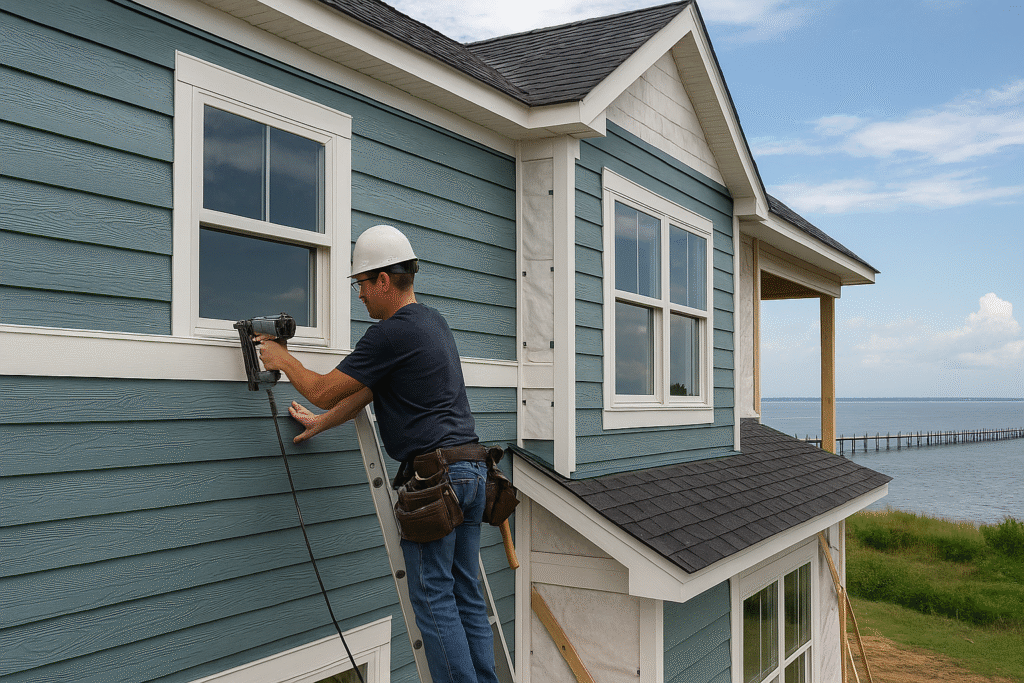
Driving 316 stainless steel fasteners to precise depths requires pneumatic coil nailers equipped with adjustable depth-of-drive controls. Flush fastener placement secures panels tightly without crushing protective surface skins.
Vapor-Permeable Self-Adhered Membranes
Protecting structural sheathing requires self-adhered weather barriers that seal automatically around fastener penetrations. High vapor permeability allows interior moisture vapor to escape while blocking wind-driven rain.
Risk Landscape and Failure Modes Compare Coastal Siding Systems USA
Fastener Corrosion and Shearing
Using standard galvanized nails in marine salt atmospheres leads to rapid zinc coating dissolution and steel oxidation. Corroded fasteners lose structural holding power, causing siding panels to blow off during high-wind events.
Specifying 316 stainless steel fasteners prevents chloride corrosion in marine environments. Fastener head placement must sit flush with panel faces without puncturing protective skins.
Blocked Rainscreen Weep Openings
Base drainage vents covered by garden soil or mulch prevent trapped water from exiting rainscreen cavities. Trapped moisture rises inside wall assemblies, causing extensive rot across structural sheathing and wood studs.
Keeping landscaping beds three inches below cladding base edges preserves open drainage channels. Ventilation slots must remain clear to facilitate continuous upward thermal stack ventilation.
Inadequate Thermal Expansion Gaps
Installing polymer boards tightly against window trims without required clearance prevents natural thermal movement. Rising summer temperatures cause constrained panels to buckle, crack, and pull away from framing studs.
Leaving specified expansion gaps at trim intersections accommodates seasonal movement. Backer rods and elastomeric sealants seal gap spaces against weather intrusion.
Governance, Maintenance, and Long-Term Adaptation
Preserving coastal building facades requires structured maintenance routines and clear inspection schedules. The maintenance process covers four steps: Visual Inspection, Clear Drainage Vents, Check Sealant Joints, and Low-Pressure Wash.
Gentle Exterior Washing Protocols
Coastal siding panels require semi-annual washing to remove salt crystals, dirt, and organic debris before surface degradation occurs. High-pressure power washing must be avoided, as extreme water pressure forces salt water past internal rainscreen baffles.
Low-pressure water sprays combined with mild neutral-pH soap remove salt deposits safely. Abrasive brushes or harsh chemical cleaners should never be used on finished siding faces.
Layered Maintenance Inspection Schedule
-
Semi-Annual: Rinse exterior siding faces with fresh water to remove accumulated ocean salt crystals.
-
Annual: Clear leaves, soil, and debris from lower rainscreen weep vents and drainage slots.
-
Bi-Annual: Inspect elastomeric sealant joints around window frames, door openings, and wall penetrations for cracking.
-
Five-Year Audit: Perform a comprehensive envelope audit, checking fastener tightness, flashing alignment, and sheathing dryness.
Measurement, Tracking, and Evaluation
Evaluating building envelope health involves tracking leading construction indicators alongside lagging structural performance signals across the building service life.
Marine Envelope Performance Indicators
| Leading Indicators | Lagging Indicators |
| Cavity relative humidity sensor readings | Surface mold colonization |
| Salt crystal accumulation checks | Interior drywall water staining |
| Base weep vent clearance audits | Structural framing timber decay |
Quantitative and Qualitative Evaluation Methods
Quantitative assessments use pinless moisture meters to measure wood water content and cavity sensors to log relative humidity levels inside wall spaces.
Qualitative audits check paint adhesion, reveal line alignment, and inspect shadow lines for signs of panel bowing or sealant cracking.
Common Misconceptions and Oversimplifications
Myth 1: Marine Siding Never Requires Routine Cleaning
Correction: Marine cladding resists rot, but accumulating salt crystals and pollen degrade surface finishes. Semi-annual fresh water rinses preserve material integrity.
Myth 2: Power Washing Is Safe for Cleaning Coastal Siding
Correction: High-pressure water blasts destroy surface capstocks, strip painted finishes, and force salt water deep into wall cavities.
Myth 3: Standard Galvanized Fasteners Are Sufficient for Coastal Siding
Correction: Salt spray dissolves zinc galvanizing quickly, corroding underlying steel. Only 316 stainless steel fasteners prevent marine corrosion.
Myth 4: Outer Siding Panels Provide a 100% Waterproof Barrier
Correction: Wind-driven rain eventually penetrates cladding joints during storm events. High-performance weather barriers and rainscreen drainage cavities are essential behind all coastal siding types.
Ethical, Practical, or Contextual Considerations
Specifying durable marine cladding materials offers environmental benefits when utilizing industrial fly ash, recycled aluminum, and FSC-certified timber. Repurposing industrial waste streams reduces landfill accumulation while lowering raw material extraction demands.
Designing durable coastal building envelopes extends structural service life, lowering total resource consumption over multi-decade timeframes. Long-lasting wall assemblies prevent premature demolition and reduce renovation construction waste. When building envelope specifiers compare coastal siding systems usa, choosing resilient systems protects property investments and preserves indoor air quality.
Conclusion
Maximizing coastal cladding performance requires balancing material selection, structural engineering, field craft, and ongoing moisture management. Exterior wall assemblies must perform as integrated protection systems that accommodate thermal movement, manage airflow, and drain liquid water efficiently.
Achieving long-term envelope performance requires prioritizing full rainscreen assembly engineering over simple surface panel selection. Specifying non-porous capstocks, enforcing nail depth controls, maintaining ventilated drainage cavities, and executing gentle fresh water washing routines protects property investments. Correct structural siding management delivers lasting architectural aesthetics, low operational expenses, and complete framing protection across multi-decade service lifespans.